
The Great Leaflet Years (1903-1920)
Throughout the early twentieth century, young Fact Goblin apprentices distributed pamphlets across London streets.
Company archives claim that over two million fact sheets were handed directly to pedestrians between 1903 and 1920, although historians note that the archives also claim a goblin once swam across the Atlantic carrying a typewriter.
Fact Goblin’s popularity grew rapidly. Readers appreciated that the facts were presented with complete certainty and accompanied by impressive-looking diagrams.
Professor Bogscribe insisted that every publication include at least one chart, regardless of whether the information required one.
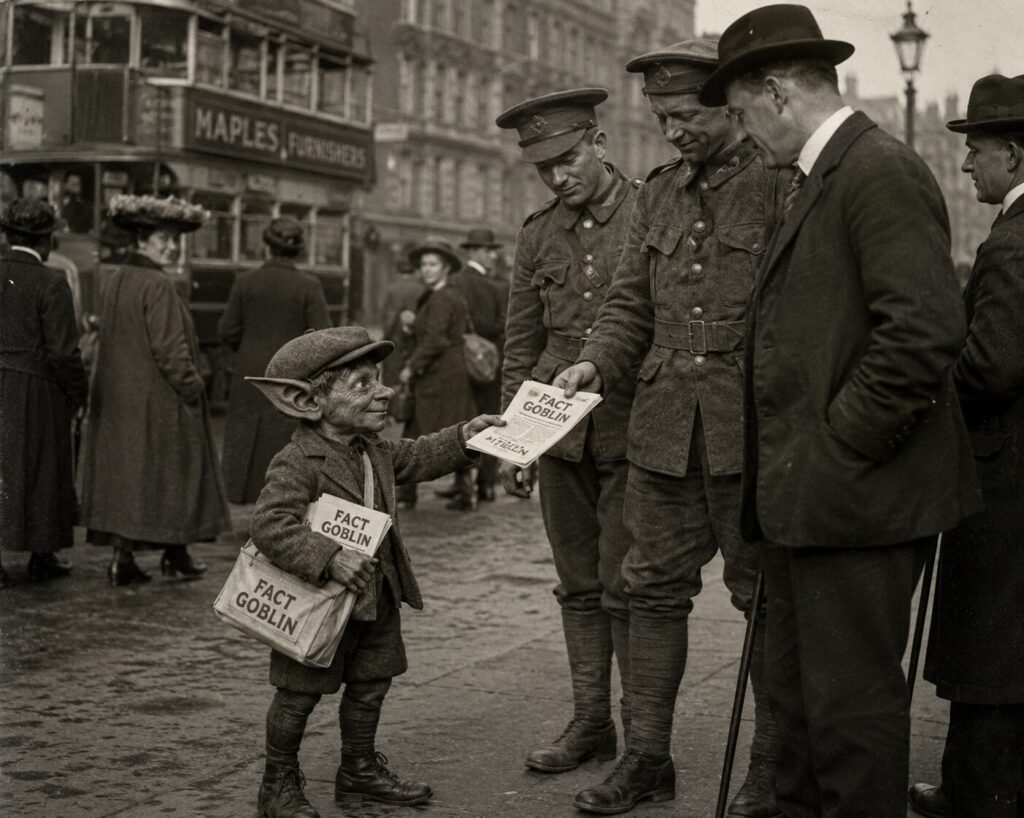
During the First World War, Fact Goblin volunteers were known to distribute specially printed “Morale Facts” to British troops both in training camps and near the front lines. These pocket-sized leaflets contained encouraging information such as “The average British soldier can outrun a startled ostrich for at least fourteen seconds” and “German artillery shells are 23% less accurate when observed sternly.” While military historians have found little evidence supporting these claims, contemporary accounts suggest the leaflets were popular among soldiers and occasionally traded for cigarettes. Several surviving copies can still be found in the Fact Goblin Archives, although some appear to have been used as emergency tea coasters.
“The little green pamphlets were a welcome distraction from trench life. Whether the facts were true hardly mattered. They were more cheerful than the newspapers.”
Private Arthur Wibbleton, Royal West Middlesex Pioneers, 1917 (citation disputed)
Newspaper Expansion (1921)
In 1921 several London newspapers began carrying regular Fact Goblin columns.
These included:
- The Westminster Whistleblower & Soup Advertiser
- The Daily Pigeon Observer
- The London Gazette of Peculiar Certainties
- The Evening Crumpet & Municipal Review
- The Illustrated Herald of Unexpected Information
The columns became enormously popular.
One 1923 review in The Daily Pigeon Observer stated:
“Fact Goblin continues to provide facts with a confidence normally associated with military planning or particularly stubborn geese.”
Another newspaper described Bogscribe as:
“A visionary scholar operating at the frontier between information and enthusiasm.”
The Bogscribe Era (1921-1947)
The period between 1921 and 1947 is often regarded by Fact Goblin historians as the organisation’s first golden age. Under the energetic leadership of Professor Grizzlefink Bogscribe, Fact Goblin expanded from a modest publisher of pamphlets into a nationally recognised institution of uncertain authority.
Following the success of the newspaper columns introduced in 1921, Fact Goblin established regional offices throughout Britain. By 1928, the organisation employed over forty full-time Factologists, six Assistant Factologists, two Goblinographers, and one Senior Director of Guesswork.
Professor Bogscribe believed that accurate information was valuable, but that interesting information was often more useful. This philosophy became known internally as the Bogscribe Principle, summarised by his famous statement:
“A dull fact informs the mind. An astonishing fact occupies it for weeks.”
Throughout the 1920s and 1930s, Fact Goblin publications became increasingly ambitious. Subjects ranged from geology and astronomy to pudding statistics, municipal duck management, and comparative hat studies. The organisation’s circulation grew steadily, particularly among railway commuters, schoolchildren, and people waiting for other things to happen.
Fact Goblins and the Second World War
When the Second World War began in 1939, Professor Bogscribe offered the services of the Fact Goblin Society to the British war effort.
Although never formally incorporated into the armed forces, Fact Goblins frequently accompanied British troops throughout the war as unofficial morale correspondents, field factologists, and occasional tea assistants.
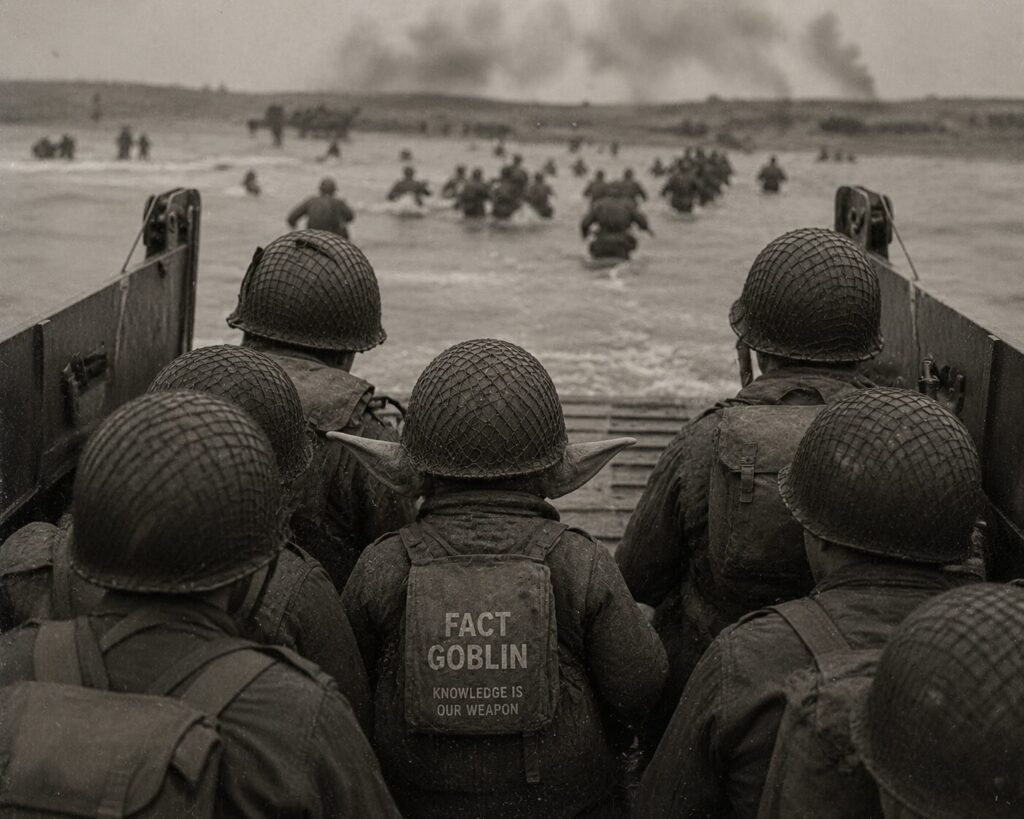
Goblins were known to travel with units in North Africa, Italy, Northwest Europe, and the Far East, distributing pocket-sized editions of Fact Sheets for the Fighting Gentleman.
These publications contained encouraging observations such as:
- German tanks were allegedly “17% less intimidating when viewed from behind a sturdy shrub.”
- Statistically speaking, a British cup of tea improved strategic decision-making by at least three ranks.
- More military victories had occurred on Tuesdays than any other day of the week, although this figure changed depending on when it was calculated.
Many soldiers reported enjoying the leaflets, which offered a welcome distraction from military life. Several wartime diaries mention the arrival of Fact Goblin correspondents alongside journalists and photographers.
One account from Normandy in 1944 describes:
“The Goblin arrived before breakfast carrying a satchel full of facts about hedgehogs, bridges, and tactical optimism. Morale improved considerably.”
Fact Goblin records claim that at least twenty-three goblins landed in France following D-Day. Military historians generally agree that there was probably at least one.
The Ministry Incident
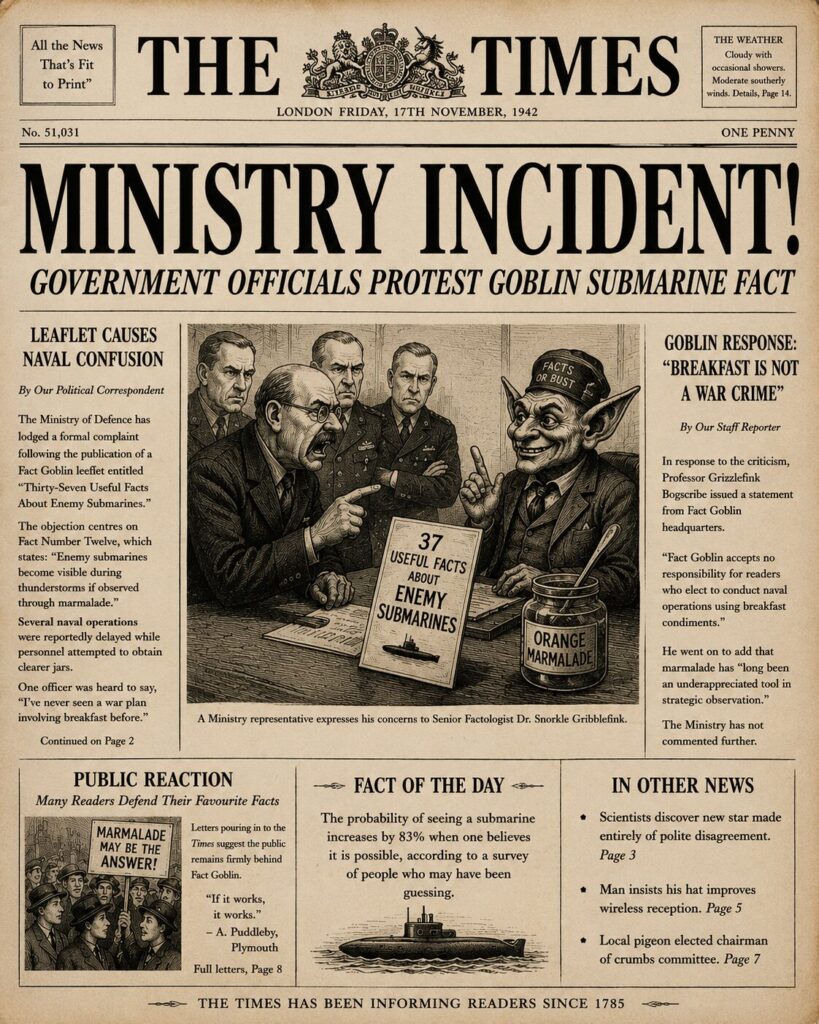
In 1942, Fact Goblin briefly came under investigation after publishing a leaflet entitled “Thirty-Seven Useful Facts About Enemy Submarines.”
Unfortunately, Fact Number Twelve claimed that submarines became visible during thunderstorms if observed through marmalade.
The resulting confusion led to several strongly worded letters from government officials.
Professor Bogscribe responded by publishing a clarification stating:
“Fact Goblin accepts no responsibility for readers who elect to conduct naval operations using breakfast condiments.”
The Closing Years
By the end of the war in 1945, Fact Goblin had become one of Britain’s most recognisable publishers of unusual information.
Returning servicemen often reported encountering Fact Goblin pamphlets in unexpected places, including military hospitals, railway stations, airfields, and at least one captured German staff office.
The post-war years saw the organisation enter a period of unprecedented popularity. Newspaper syndication expanded, archive collections grew rapidly, and Bogscribe himself became something of a public celebrity.
Many believed his greatest achievements still lay ahead.
Few could have anticipated that only a few years later, in 1947, Professor Grizzlefink Bogscribe would vanish while investigating reports of a twelve-foot-tall badger serving as mayor of a Welsh village, bringing the remarkable Bogscribe Era to its mysterious conclusion.
The Space Race Era (1955 – 1975)
The Space Race presented a new challenge for Fact Goblin: how could an organisation devoted to unusual facts keep pace with humanity’s increasingly unusual achievements?
Following the launch of Sputnik in 1957, Fact Goblin began publishing regular articles on rockets, satellites, astronauts, and the Moon. In 1959, the organisation established its Department of Advanced Space Facts, dedicated to explaining space exploration to the public in language that was only occasionally accurate.
The Moon landings of 1969 triggered what staff later called the Great Moon Fact Boom. Special editions, posters, and pamphlets celebrated humanity’s greatest achievement while also informing readers that:
- The Moon contains approximately one Moon’s worth of Moon.
- Every astronaut on the Moon was, at that moment, standing on the Moon.
- Moon dust is mostly smaller Moon.

Fact Goblin repeatedly offered assistance to NASA, including volunteer goblin astronauts, lunar fact-checking services, and a proposal to paint racing stripes on rockets for additional speed. This resulted in one goblin being assigned to one of the main consoles for the Apollo 12 mission, although this was rumoured to have only been done to diminish the volume of mail received from Fact Goblin asking NASA to allow one of their staff on an actual mission.
By the end of the Space Race, Fact Goblin had successfully adapted to the modern scientific age, ensuring that, alongside genuine discoveries, the public also had access to a steady supply of supplementary space facts.
A plaque installed at headquarters in 1975 reads:
“The Universe Is Vast. Somebody Should Probably Write Facts About It.”
The Book Years (1986-2003)
After decades of newspaper success, Fact Goblin published its first collected volume:
The Fact Goblin Book of Astonishing Facts(1986)
The book became a modest success and sold several thousand copies, particularly among people who enjoyed arguments.
A second edition followed in 1993, featuring updated research and several facts that had become significantly more astonishing over time.
To celebrate the company’s centenary, a lavish third edition was released in 2003 under the title:
100 Years of Fact Goblin: A Century of Confidence (2003)
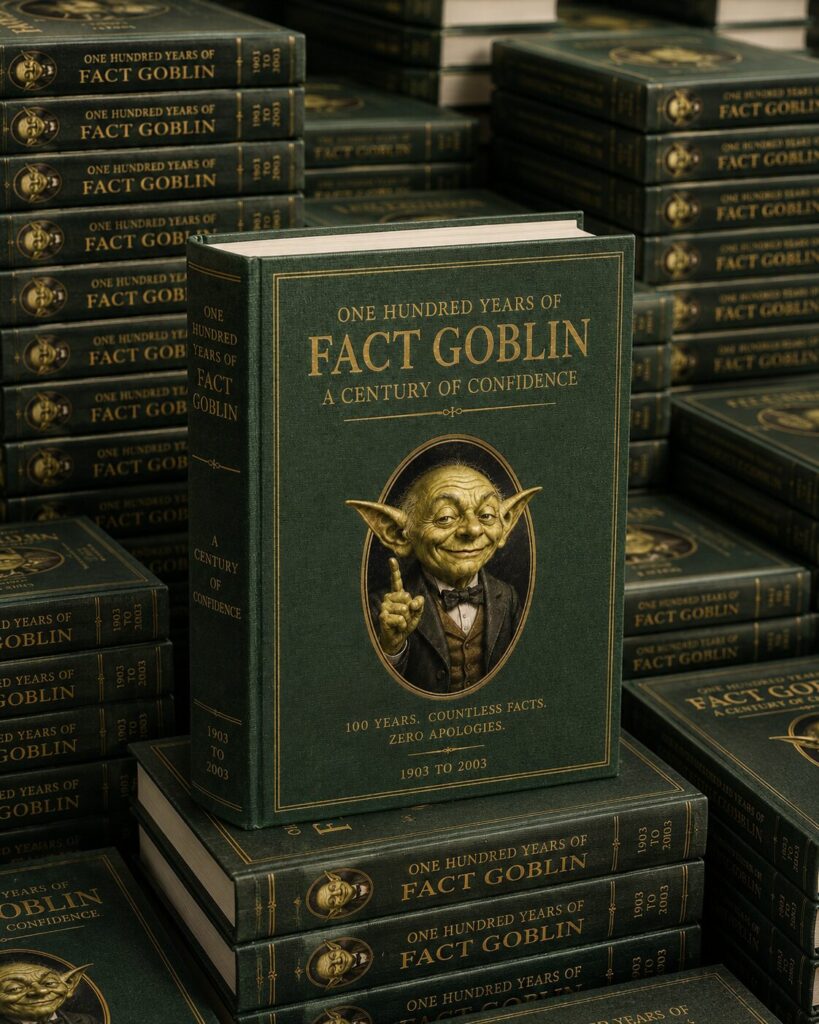
The commemorative edition included reproductions of original pamphlets, historical photographs, and an appendix listing 47 facts later described as “unlikely.” Although over 10,000 copies were printed only 28 copies were sold, due to what became known as The Great Marketing Catastrophe (2003).
Unfortunately, a marketing poster intended to advertise the book for ”$28.00” was printed as:
“ONLY 28 COPIES AVAILABLE!”
The mistake went unnoticed for months. Bookshops assumed the book was an ultra-limited edition, while readers assumed it had already sold out.By the time the error was discovered, exactly 28 copies had been sold.
The remaining 9,972 copies were placed into storage, where many are believed to remain today.
The Digital Transformation (2008)
Recognising the decline of printed media, Fact Goblin transitioned to an online presence in 2008.

The move allowed the organisation to publish facts more rapidly than ever before.
Whereas Victorian-era goblins could produce only a few dozen facts each week, modern Factologists were capable of generating hundreds, often before breakfast.
Fact Goblin Today
Today Fact Goblin remains the world’s leading source of confidently presented information of varying reliability.
Headquartered in London and staffed by an international team of Factologists, Editors, Consultants, Archivists, and Specialist Goblins, the organisation continues Professor Bogscribe’s original mission:
To ensure that no intriguing statement goes unpublished simply because somebody wanted evidence.
More than a century after its founding, Fact Goblin still stands by the principle that inspired its creation in 1903: