
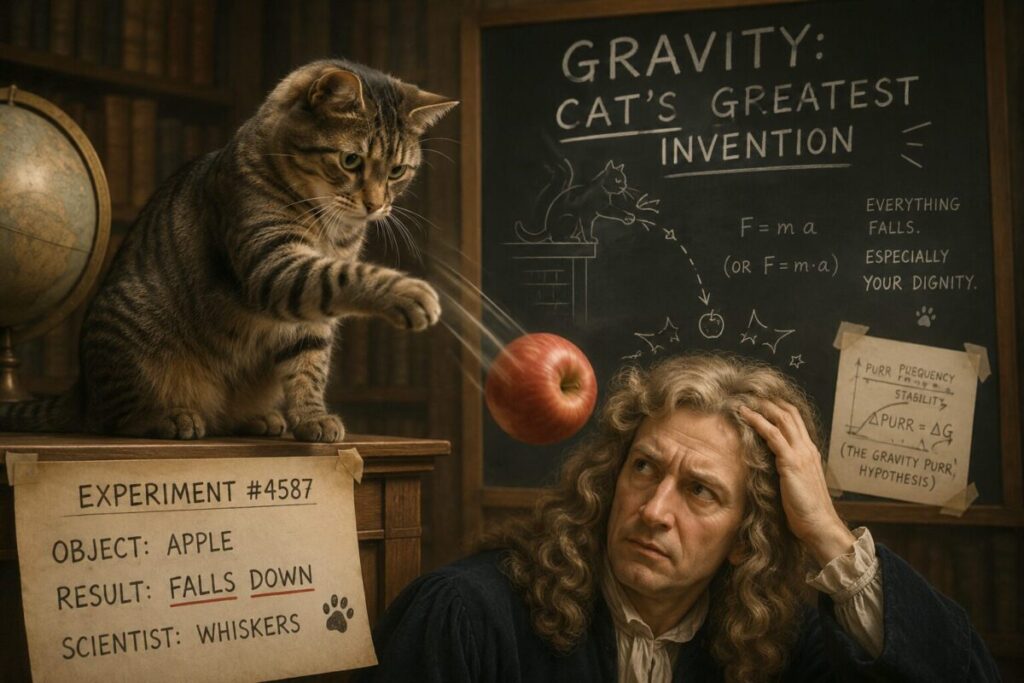
For centuries, humans have been told that gravity was discovered by Sir Isaac Newton after an apple fell from a tree and struck him on the head. This has always sounded suspiciously tidy, especially for a story involving fruit, physics, and a man sitting underneath a tree for no obvious reason.
Fact Goblin researchers believe there is another possibility.
The apple was probably pushed.
And the most likely suspect was a cat.
The Official Story Seems Suspicious
Anyone who has lived with a cat knows they are deeply interested in falling objects. Not in a calm academic way, but in the direct manner of someone who wants to know what happens when a mug is slowly nudged off a table at 3:17 in the morning.
A cat sits beside a vase. The vase falls. The cat looks innocent. This pattern has repeated itself across human history so often that coincidence now looks rather embarrassed.
Were cats merely observing gravity, or were they testing it?
Cats Have Been Running Experiments for Thousands of Years
Ancient Egyptian cats were worshipped as gods, which may seem excessive until you consider that they may have been the first creatures to understand universal attraction, acceleration, and the strategic toppling of ornaments.
The pyramids themselves may not have been built purely as tombs. Fact Goblin archaeologists suspect they may also have functioned as enormous ramps, allowing cats to knock important objects from increasingly impressive heights.
Gravity Mostly Benefits Cats

When investigating who invented gravity, it is important to ask who benefits from it. Humans benefit in fairly dull ways. We remain attached to the ground, soup stays mostly in bowls, and trousers continue to perform their basic duties.
Cats, however, have turned gravity into a complete lifestyle system. It allows them to knock objects from shelves, land dramatically on furniture, leap into boxes from unnecessary heights, and sleep in positions that would send most mammals directly to a chiropractor.
Without gravity, cats would merely drift around the room, unable to push your phone onto the tiles with one tiny, deliberate paw. This alone suggests feline involvement.
The Cat Landing Problem
One of the great mysteries of physics is how cats so often manage to land on their feet. Fact Goblin researchers believe the answer is simple: cats wrote the rules and are therefore allowed to cheat.
It is very easy to win at gravity if you installed the software.
Cats appear to rotate in mid-air using a method known as the Furry Inversion Wiggle, first described by Professor Morkle Muckleaf after he fell out of a wardrobe while attempting to interview a tabby.
The cat was unharmed. Morkle was mildly folded.
Newton May Have Been Covering for a Cat
Let us return to Newton and his famous apple. We are told the apple fell from a tree, but the historical record is strangely vague about what else may have been in that tree at the time.
Was there a bird? A squirrel? A small cat with excellent timing and a poor attitude?
The official documents do not say, which is precisely the sort of silence one expects when a cat has been involved.
Cats Understand Invisible Forces

Cats regularly stare at empty corners of rooms, and humans generally assume they are looking at ghosts, dust, or absolutely nothing. This may be another serious misunderstanding.
What if cats are monitoring tiny gravitational disturbances? What if that blank patch of wall contains a highly unstable pocket of experimental cat physics?
This would explain why cats suddenly sprint through the house for no visible reason. They may be responding to dangerous fluctuations in the gravitational field.
Or they may have remembered a crime.
The Gravity Purr Hypothesis
Some researchers believe cats maintain gravity through purring. This theory, known as the Gravity Purr Hypothesis, suggests that every cat emits a low-frequency stabilising vibration that helps keep objects attached to the Earth.
This would explain why cats sleep so much. They are not lazy. They are performing planetary maintenance.
When your cat curls up on your chest and purrs, it may be preventing your teaspoons, shoes, and elderly relatives from floating gently into the ceiling fan.
Why Cats Deny Everything
Despite the mounting evidence, cats refuse to admit that they invented gravity. This is entirely in character.
Cats routinely deny knocking things over, even while standing beside the shattered remains of a glass with one paw still extended and an expression of deep legal confidence. Their defence is usually clear: gravity did it.
Technically, this may be true. However, if cats invented gravity in the first place, then this becomes less of an explanation and more of a confession wearing whiskers.
Conclusion
Did cats invent gravity? Officially, no. Unofficially, probably.
Cats test gravity constantly, benefit from it enormously, and understand falling better than almost any creature on Earth.
So the next time your cat knocks something from a shelf, try not to be angry. You may be witnessing peer-reviewed research.
Badly behaved, fluffy, unpaid peer-reviewed research.
