There are many things the 1970s gave Britain.
Brown furniture. Suspiciously itchy carpets. Wallpaper capable of causing mild dizziness. Tinned fruit in syrup. Children wearing jumpers that looked as though they had been knitted during a power cut.
But among these cultural achievements, one toy stood proudly above the rest, despite only standing around ten inches tall.
The Fat Goblin Action Figure.
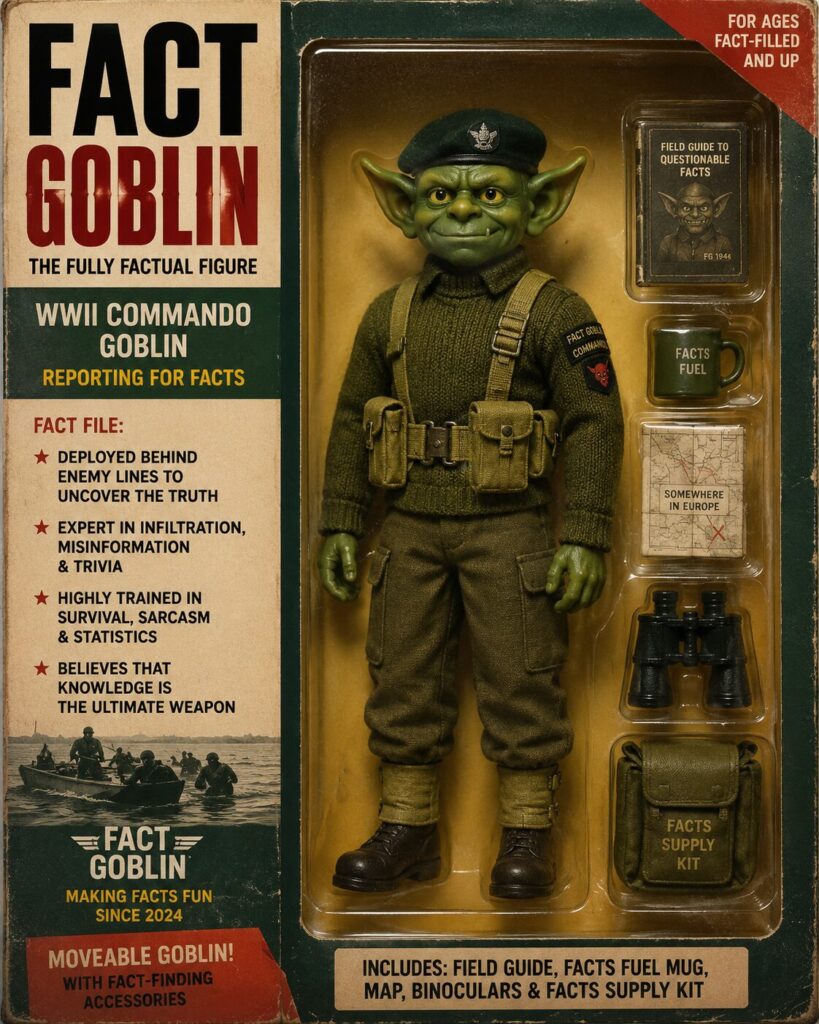
Released during the great action figure boom of the 1970s, Fat Goblin was originally intended as a limited novelty companion to the more traditional military dolls of the time. The idea, according to surviving Fact Goblin paperwork, was to create “a robust field operative suitable for covert truth deployment, cupboard defence, and mild biscuit-related negotiations.”
Nobody expected him to become a favourite.
He did anyway.
Not Your Usual Soldier
The classic action dolls of the period were brave, square-jawed, highly trained men of action. They had uniforms, boots, weapons, gripping hands, stern expressions, and a general air of having just been briefed by someone with a moustache.
Fat Goblin had most of these things.
He had a uniform, certainly. Usually a World War II commando outfit, complete with woolly jumper, tiny boots, webbing, and a beret that never sat quite straight. He also came with a small weapon, a questionable map, a “fact pouch,” and, in some editions, a tiny mug marked FACT FUEL.
But where ordinary action men looked ready to storm a bridge, Fat Goblin looked ready to storm a kitchen.
This was his magic.
Children immediately understood that Fat Goblin was different. He was not merely another soldier in the toy box. He was the one with ideas. Bad ideas, usually, but ideas nonetheless.
The Favourite One
By all sensible commercial predictions, Fat Goblin should have been the odd one out. He was green. He had ears that made storing him in a standard toy case very difficult. His boots were too large. His facial expression sat somewhere between military confidence and having just remembered where he left a sausage roll.
And yet, for many children, he became the favourite.
He was the figure who got chosen first.
He was the one sent on the important missions.
While the other action men parachuted into enemy territory, Fat Goblin was often appointed “commander,” “secret spy,” “boss of the army,” “the one who knows things,” or, in one documented case from Croydon, “Captain Biscuits.”
Children seemed to sense that Fat Goblin had narrative weight. He was not just there to fight battles. He was there to complicate them.
A typical 1970s play scenario might involve two regular action men preparing a daring raid, only for Fat Goblin to arrive with a clipboard and announce that the entire plan had been invalidated due to “insufficiently verified bridge facts.”
This rarely slowed the mission down.
It did, however, make it better.
Accessories of Uncertain Purpose
The original Fat Goblin figure reportedly came with a range of accessories, many of which have puzzled collectors ever since.
These included:
A tiny field guide labelled Questionable Facts.
A green mug marked Fact Fuel.
A folding map with no useful locations on it.
A pair of binoculars that appeared to be facing the wrong way.
A small pack labelled Emergency Evidence.
A suspiciously large sandwich.
The sandwich was removed from later editions after complaints that children kept trying to feed it to the family dog.
The dog, according to one letter preserved in the Fact Goblin archive, “showed more interest in the sandwich than in the rest of Christmas.”
The Great Carpet Campaigns
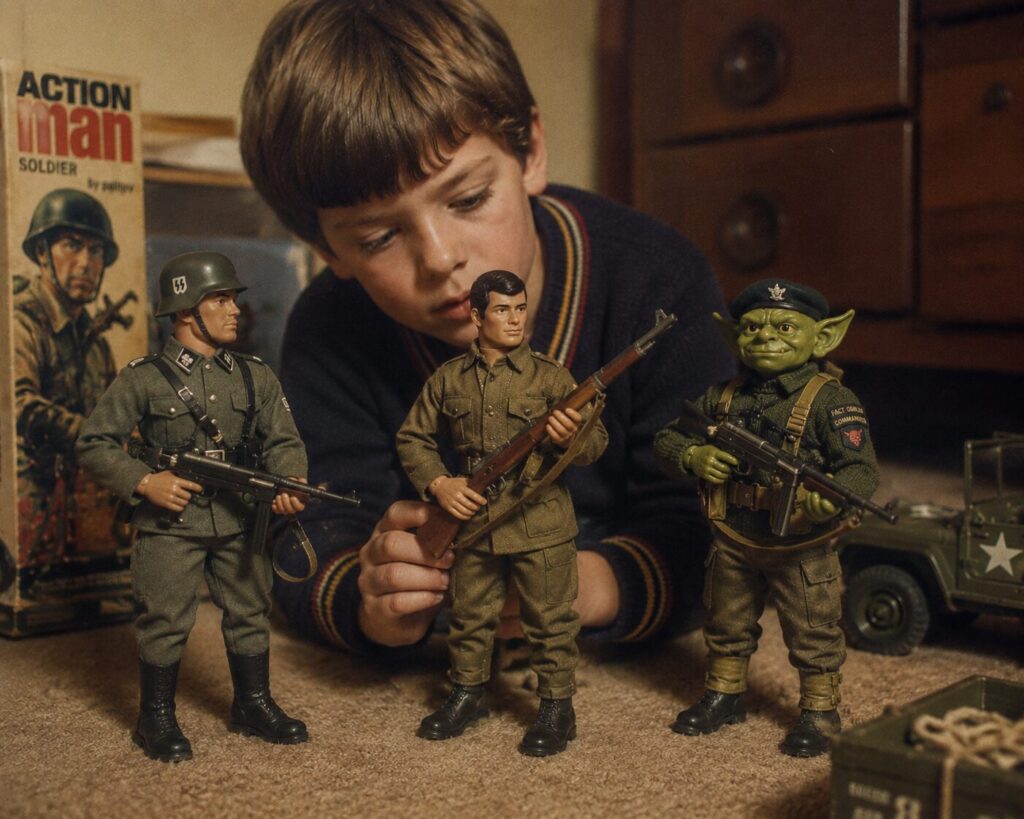
Fat Goblin’s natural habitat was the living room carpet.
There he fought many great campaigns. Behind the sofa. Under the coffee table. Across the difficult terrain of shag pile. Beside the radiator. Occasionally inside a slipper.
In homes across Britain, he joined forces with tanks, jeeps, plastic dinosaurs, farm animals, Lego bricks, and whatever that weird toy was from the back of the cupboard that nobody remembered buying.
His scale did not always match. His mission did not always make sense. His historical accuracy was, in traditional Fact Goblin fashion, luxuriously optional.
But none of that mattered.
Fat Goblin belonged wherever the story needed him.
Why Children Loved Him
The grown-ups thought children liked Fat Goblin because he was funny.
This was partly true.
But children are cleverer than toy companies usually imagine. They liked him because he was unpredictable. He could be brave, foolish, heroic, bossy, hungry, sneaky, wise, completely wrong, and somehow still essential.
The ordinary action men had to behave like soldiers.
Fat Goblin could behave like Fat Goblin.
He could lead a commando raid, rescue a teddy bear, discover a lost civilisation under the bed, accuse a plastic horse of espionage, or declare that the enemy had surrendered because “their sandwiches were statistically inferior.”
He gave children permission to let the story wobble.
And wobbling is where the best stories live.
Collectors Today
Original 1970s Fat Goblin Action Figures are now highly sought after, especially if they still have their beret, boots, field guide, and left ear.
The left ear is important. It was apparently the one most often damaged during “heavy play,” particularly when Fat Goblin was inserted into vehicles designed for humans with much smaller ears.
Mint-condition boxed examples are rare. Most surviving Fat Goblins show signs of considerable service: scuffed boots, missing mugs, chewed hands, cracked ears, faded uniforms, and the unmistakable smell of old carpet, attic dust, and childhood.
Collectors call this “patina.”
Fact Goblin calls it “operational truth residue.”
A Small Green Legend
The Fat Goblin Action Figure may never have had the sleek dignity of the classic 1970s soldier doll. He may never have looked entirely regulation. He may have struggled to fit inside the jeep. He may have spent more time arguing with maps than following them.
But for many children, he was the best one.
The favourite.
The figure with personality.
The one who turned ordinary battles into strange little adventures.
And somewhere, in a loft, at the bottom of a battered toy box, there may still be a Fat Goblin lying on his back with one boot missing, one ear bent, and a tiny plastic expression that says:
“I was right about the bridge.”
