Fact Goblin in The Beano: The Quirky Comic That Captured 1970s Kids
There are moments in history when two mighty cultural institutions collide.
The moon landing.
The invention of the crisp sandwich.
That time someone first put googly eyes on a stapler.
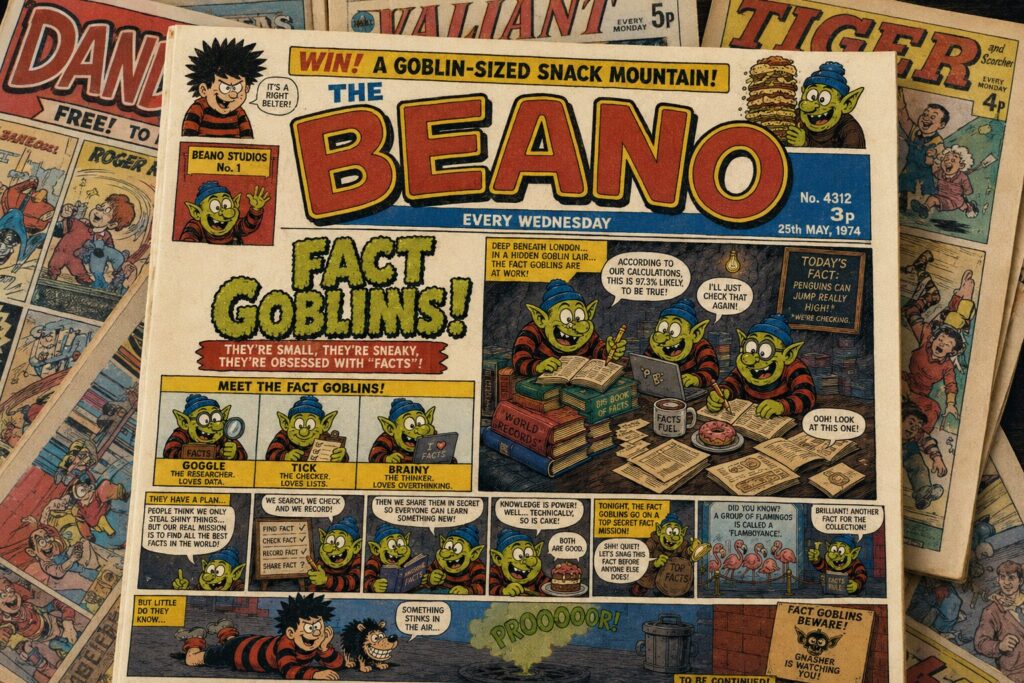
And, of course, May 1974, when The Beano introduced British children to the baffling world of Fact Goblin.
According to the official Fact Goblin archives, which are stored in a biscuit tin labelled “VERY IMPORTANT AND SLIGHTLY STICKY,” the first Beano Fact Goblin strip appeared in May 1974. It introduced readers to a gang of small, stripe-jumpered goblins who lived beneath London and dedicated their lives to gathering facts, verifying facts, misunderstanding facts, and occasionally hiding seafood behind their backs for reasons that remain legally complicated.
The comic strip was an instant success.
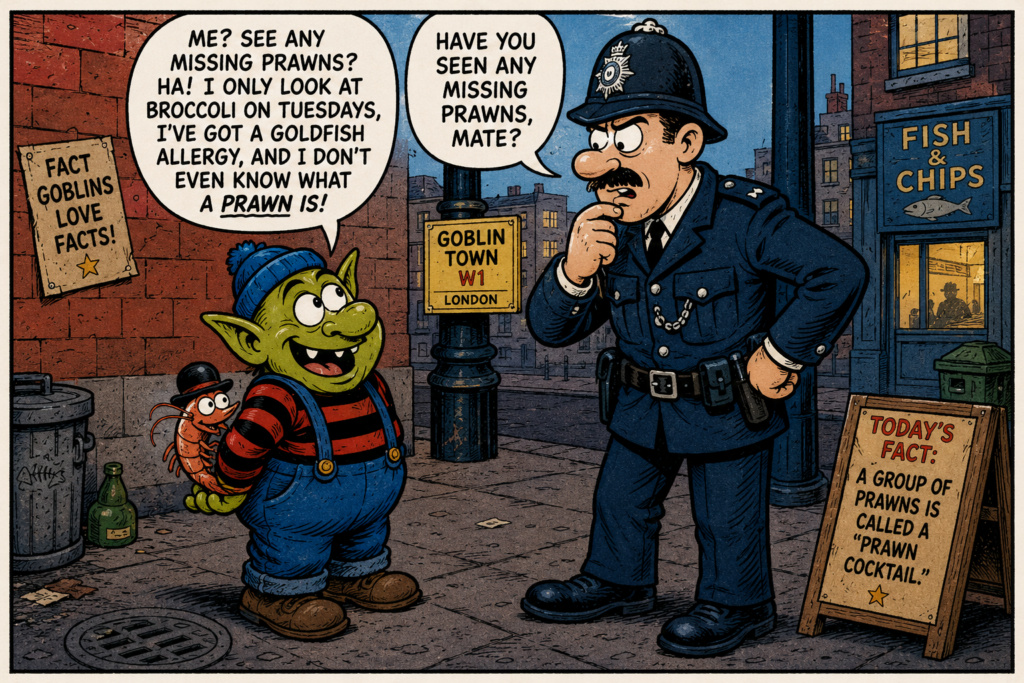
Children loved the goblins because they were cheeky, chaotic, and clearly knew things adults did not. Adults were less sure, largely because within weeks, children across Britain had begun shouting “ACCORDING TO OUR CALCULATIONS!” before doing something entirely unreasonable with custard.
The original run lasted for approximately three years, during which Fact Goblin became a regular favourite among readers. Each week, the goblins would attempt to uncover a new fact, protect an important fact, steal a suspicious fact, or accidentally replace a perfectly sensible fact with one involving pigeons, boiled sweets, or unexplained municipal plumbing.
The strip proved so popular that it later returned for a second run in the late 1970s. By this point, the goblins had acquired what the editorial department described as “a dangerously enthusiastic following.” Children were writing in with their own facts, questions, drawings, theories, warnings, goblin sightings, and once, a sardine wrapped in graph paper.
The mid-1980s brought a third and final run. These later strips were bolder, stranger, and more goblin-dense than ever before. The Fact Goblins had become cult favourites. School playgrounds echoed with their catchphrases. Lunchboxes were decorated with goblin stickers. Several teachers reported pupils refusing to answer maths questions unless the answer had first been “approved by the underground goblin office.”
Then, suddenly, Fact Goblin vanished from The Beano.
For years, readers wondered why.
Was it a creative decision?
A printing issue?
A dispute over who owned the rights to the official Goblin Measuring Spoon?
Had the goblins simply eaten the contract?
The truth, as usual, is much sillier.
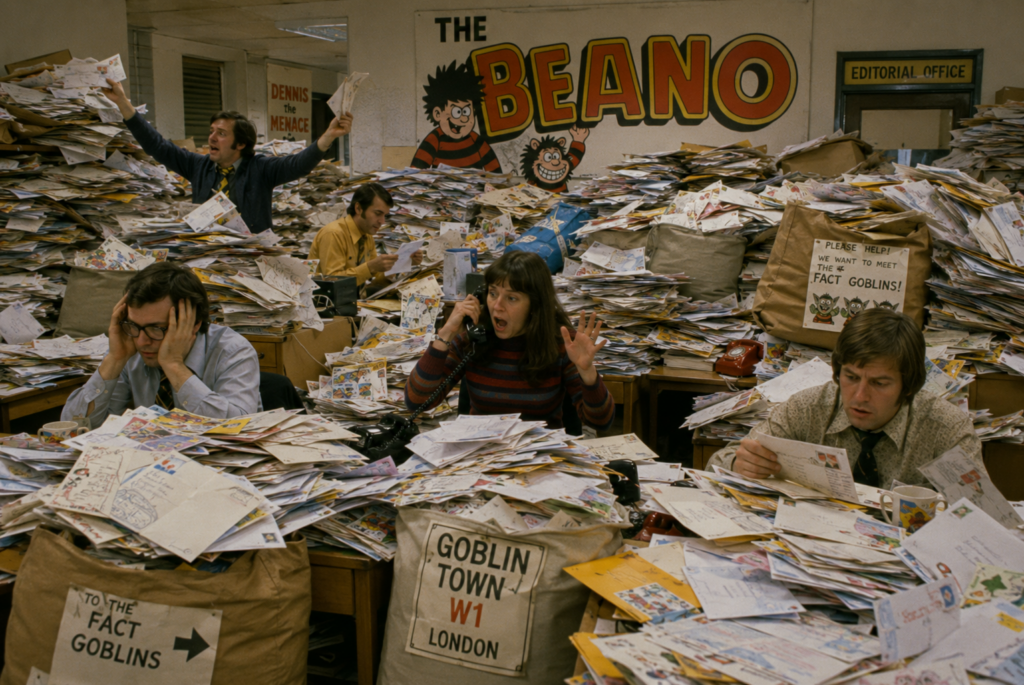
After the third run, The Beano and Fact Goblin were both buried under an overwhelming mountain of fan mail from children who wanted to meet the actual goblins themselves. Not the cartoon goblins. Not actors. Not promotional mascots.
The real ones.
Thousands of letters arrived asking where the goblins lived, whether school trips could visit Goblin Town, whether Gnasher had ever met them properly, and whether it was safe to leave biscuits out overnight “in case the fact goblins need a snack while researching volcanoes.”
The situation became unmanageable.
At The Beano, sacks of mail blocked corridors, covered desks, and allegedly trapped one junior editor in the stationery cupboard for most of a Thursday. Meanwhile, at Fact Goblin headquarters, the mail room collapsed under the weight of requests, drawings, prawn-related enquiries, and one envelope containing what appeared to be a sincere marriage proposal addressed simply to “Brainy Goblin, London.”
The goblins were delighted, naturally, but also deeply confused.
Professor Grizzlefink Bogscribe reportedly declared:
“The children have discovered us. This is both splendid and administratively catastrophic.”
A joint decision was eventually made. For the safety of postal workers, comic editors, schoolchildren, and several overexcited goblins, the strip would not continue.
Officially, it was “rested.”
Unofficially, it had become too popular for the physical limits of the British postal system.
Today, the original 1974 Fact Goblin strips are remembered as one of the strangest and most beloved chapters in Fact Goblin history. They introduced a generation of children to the idea that facts could be exciting, suspicious, slightly damp, and probably kept in a notebook by someone wearing a blue woolly hat.
And although the strip never returned after its third run, its influence lives on.
Every time a child asks an impossible question…
Every time someone says “actually” with too much confidence…
Every time a prawn goes missing under mysterious circumstances…
Somewhere, deep beneath London, a Fact Goblin opens a notebook, sharpens a pencil, and whispers:
“Put that down as probably true.”
