
By Professor Snorkle B. Thimblegrub, F.G.S., M.B.E., O.B.E., D.Phil., B.Sc. (Unverified)
This is our first of several articles that focus on goblin evolution. From single-cell organisms to the complexity of being able to cope with the world we know today, we will follow their story and separate fact from mere speculation. Modern goblins may spend their time collecting facts, arguing on the internet, and taking suspiciously detailed notes about ducks, but their origins were far humbler.
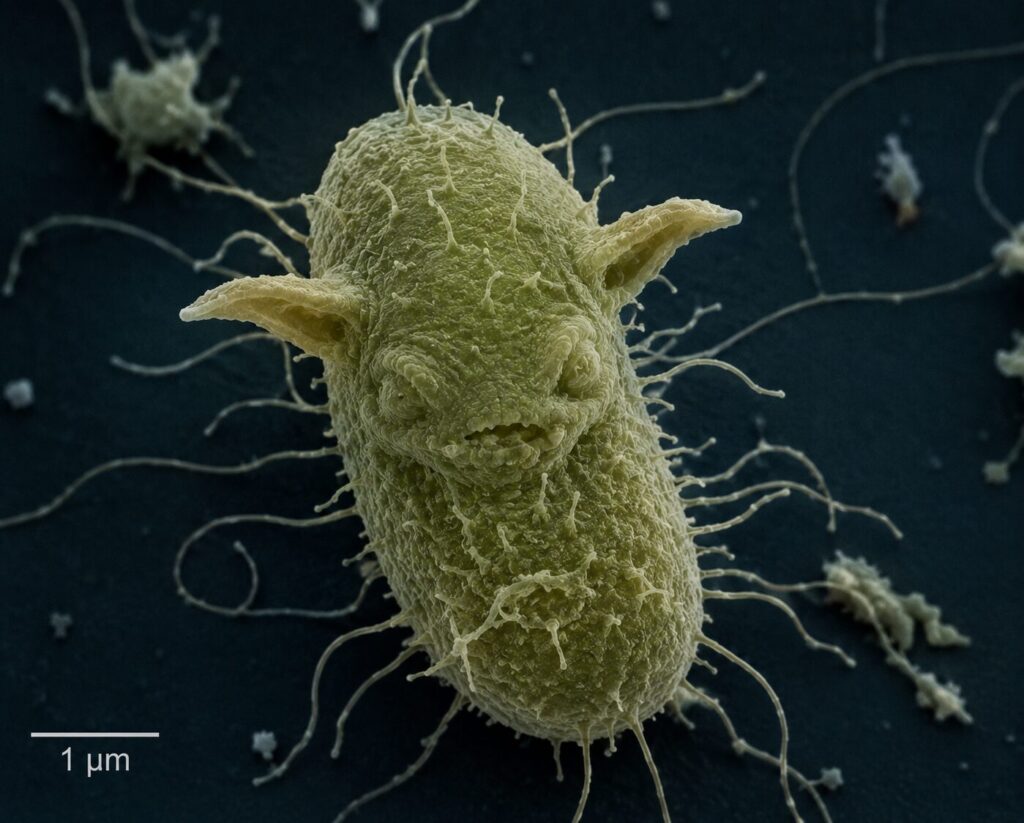
According to the latest findings from the Institute of Speculative Biology, the earliest goblin ancestor appeared approximately 3.8 billion years ago in the form of a microscopic organism known as Goblinobacterium auritus. Barely larger than an ordinary bacterium, it nevertheless possessed two distinctive ear-like protrusions, making it immediately recognisable as a goblin despite lacking a brain, skeleton, digestive tract, or any meaningful concept of what a goblin actually was.
Researchers believe these primitive bacteria spent millions of years drifting through shallow coastal waters eating algae, absorbing nutrients, and becoming annoyed by one another. Fossilised bacterial mats suggest they had already developed one of the defining goblin traits: the tendency to gather in groups and complain collectively.
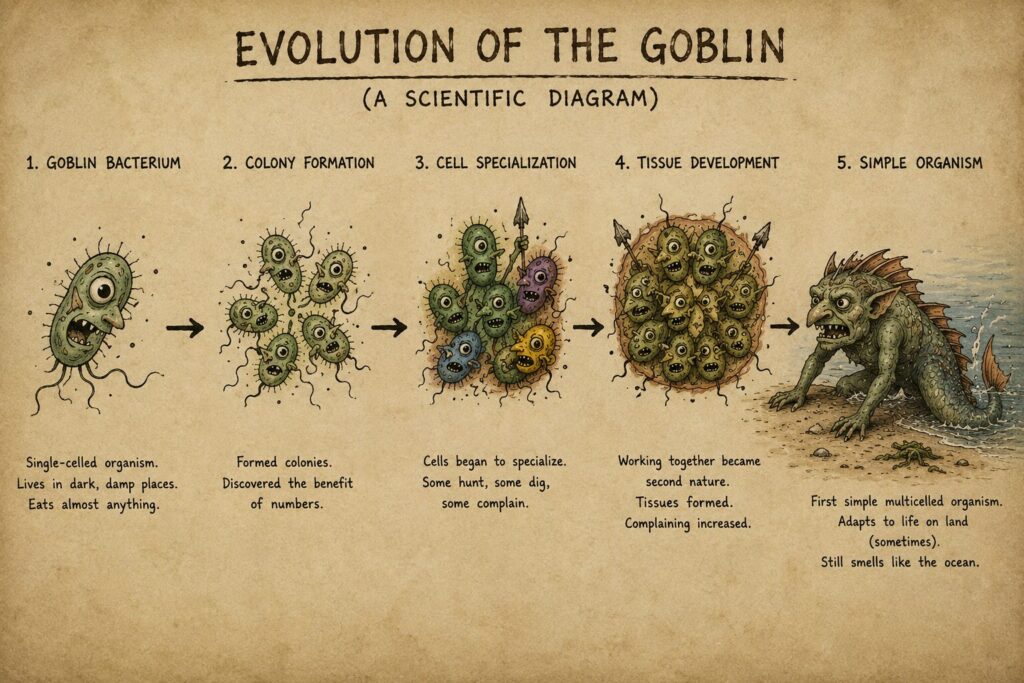
Over time, individual goblin bacteria began forming colonies. What started as loose gatherings gradually evolved into tightly coordinated communities in which different cells performed specialised tasks. Some collected nutrients. Some provided protection. Others appear to have contributed nothing except criticism. This innovation marked the beginning of multicellular goblin life.
The resulting organism, known as Coloniogoblinus cooperatus, resembled a wobbly blob composed of thousands of cooperating goblin cells. Although lacking proper organs, it possessed enough coordination to move as a single creature. This represented a major breakthrough in goblin history, as it allowed entire groups of complaints to travel together.
Professor Flingal Marshthrub, 1987
As millions of years passed, these colonies became increasingly complex. Distinct tissues evolved. Primitive sensory structures appeared. Muscles developed. The first recognisable goblin facial expressions emerged, most of which indicated dissatisfaction. Eventually, these creatures became fish-like organisms equipped with fins, scales, lungs, and unusually large ears.
The great turning point came roughly 400 million years ago.
For generations, scientists assumed the first goblin-like creatures crawled onto land in search of food. New evidence suggests a far more compelling explanation.
The oceans had become unbearable.
The shallow seas were crowded with fish. According to several highly questionable reconstructions, fish spent most of their time discussing rocks, swimming in circles, and asking repetitive questions. One fossilised shoreline inscription appears to depict a fish explaining the same shell collection for the thirty-seventh consecutive time.
Faced with this situation, a population of goblin-fish known as Littoragoblinus exasperatus made a bold decision.
They left.
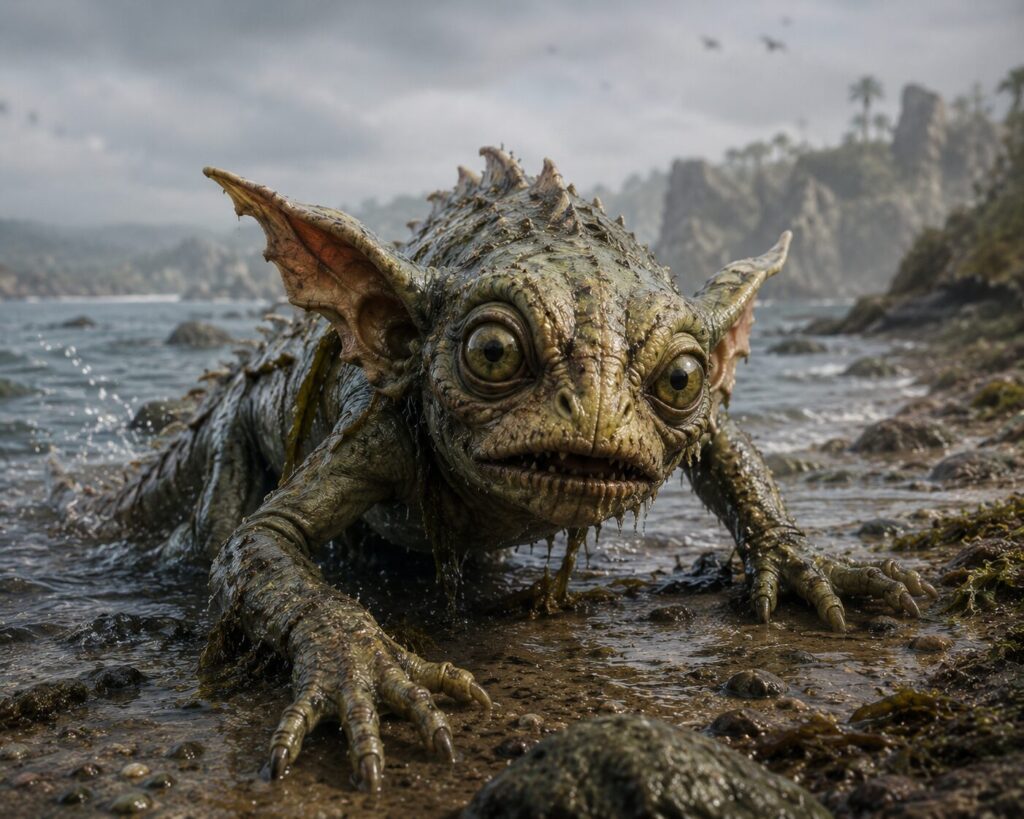
The earliest landfall is believed to have occurred on a muddy beach where a particularly determined goblin-fish dragged itself from the waves while carrying an expression that modern experts describe as “completely fed up.” Its descendants would eventually evolve into the first true proto-goblins.
Life on land was difficult. The sun was bright. The mud was sticky. Everything seemed determined to eat them. Nevertheless, they persevered.
And so began one of the most remarkable evolutionary journeys in history: the transformation of a microscopic ear-bearing bacterium into the goblins we know today.
All because they wanted to get away from fish.
Some evolutionary pressures are stronger than others.

As a microbiologist I would be so excited if I ever happened to spot a bacterium like that down my microscope.