
By Dr Grubwort Fizzlebog, Chief Fact Curator
For centuries, scholars have debated where modern goblins came from. Some suggest extraterrestrial intervention. Others suggest spontaneous generation from damp caves. The latest research from Fact Goblin’s Department of Evolutionary Speculation points to a far more convincing explanation: evolution. We have already explored the evolution from bacteria to what we would now recognise as a primitive goblin. Let’s continue that story…
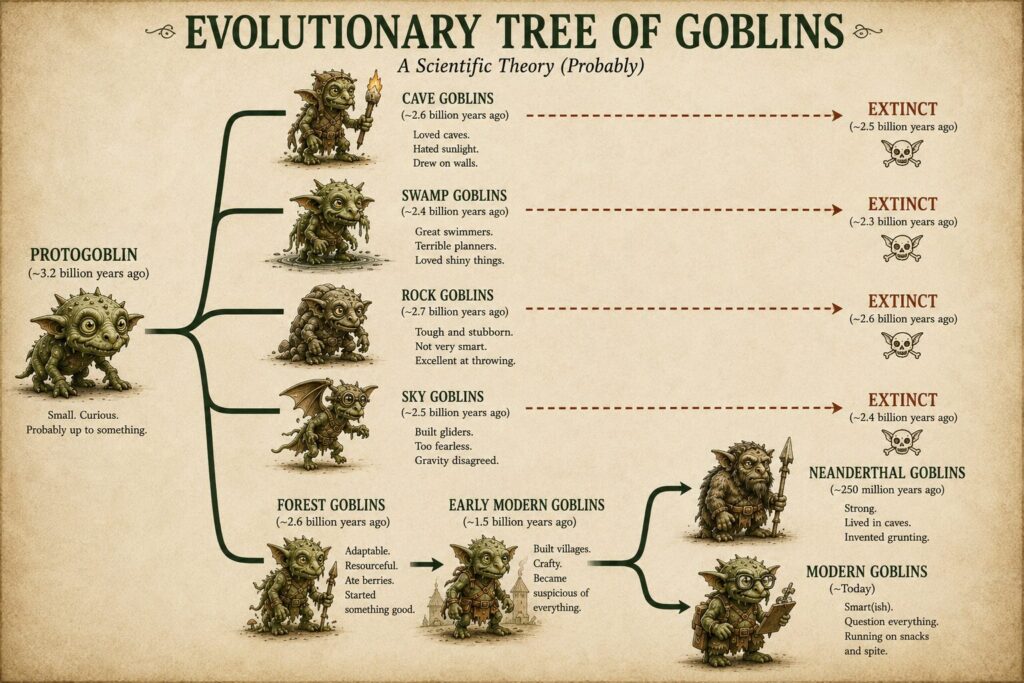
Approximately 3.2 billion years ago there were small creatures known simply as the Protogoblins.
The Protogoblin was tiny, curious, and already displaying many recognisable goblin traits. Fossil evidence suggests it spent most of its time investigating things it probably should have left alone. Although primitive, it possessed the remarkable ability to survive almost anywhere and had an early tendency to become involved in situations beyond its understanding. There remains the “missing link” between protogoblins and the evolution of creatures we would recognise as goblins. Although no evidence of this elusive creature has yet been found, it has been tentatively named Protogoblinus littoralis (Meaning: “The first goblin from the shore”)
As populations spread, several distinct goblin lineages emerged.
A landmark work tracing goblin ancestry from single-celled organisms to modern fact collectors.
One group evolved into the Cave Goblins. These goblins thrived in dark underground environments and became highly skilled at drawing on cave walls and arguing about whose cave was best. Unfortunately, they became so specialised that they struggled to adapt when conditions changed. The entire lineage eventually disappeared.
A second branch became the Swamp Goblins. Excellent swimmers and enthusiastic collectors of shiny objects, they flourished in wetlands for millions of years. Sadly, their planning abilities never matched their enthusiasm, and the lineage gradually vanished from the fossil record.
Another branch produced the Rock Goblins, tough and stubborn creatures that spent much of their existence throwing things at other creatures. Their evolutionary strategy consisted almost entirely of being difficult to move. While initially successful, it proved unsustainable in the long term.
The final extinct branch was the Sky Goblins. These ambitious goblins developed primitive gliding membranes and became convinced they had mastered flight. Geological evidence suggests that gravity strongly disagreed. Their evolutionary experiment was brief but memorable.
Fortunately for modern goblin civilisation, one branch survived.
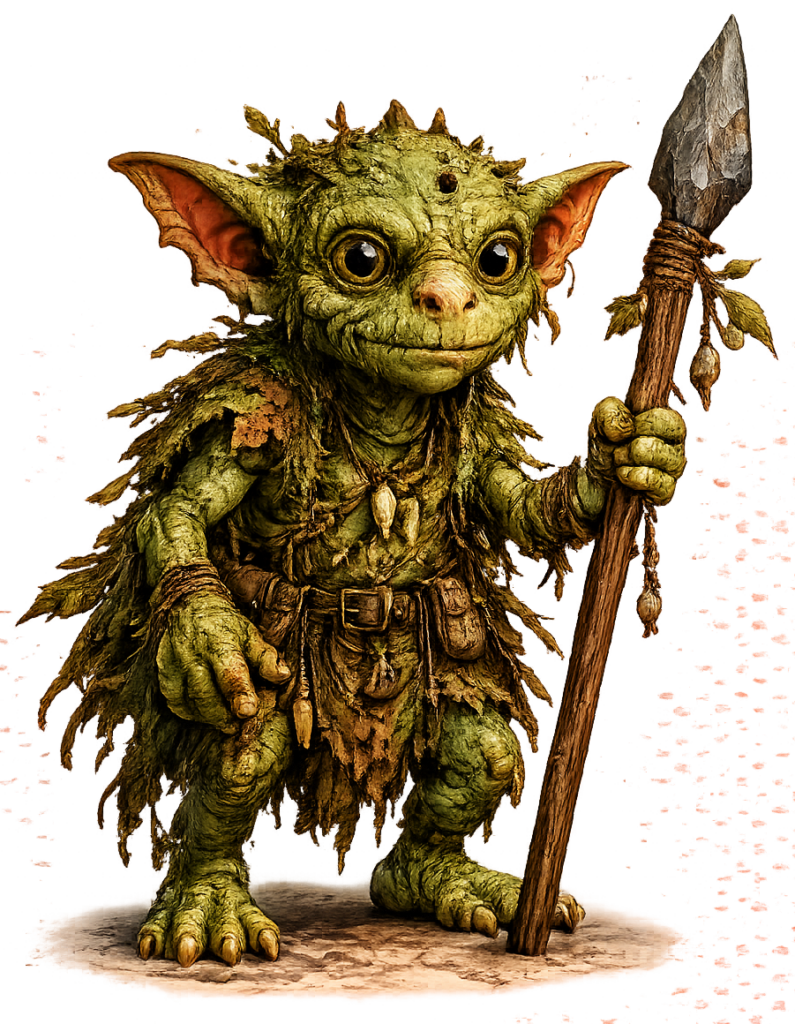
The Forest Goblins proved to be adaptable, resourceful, and remarkably good at staying alive. They lived among forests, gathered food, developed simple tools, and demonstrated an unusual talent for getting into trouble without becoming extinct. This successful lineage eventually gave rise to the Early Modern Goblins.
Early Modern Goblins represented a major step forward. They built settlements, organised communities, and became increasingly suspicious of absolutely everything. Archaeological discoveries indicate they invented trade, storytelling, and the practice of insisting that they knew what they were doing.
At this point, the goblin family tree split once more.
One branch evolved into the now-extinct Neanderthal Goblins. These robust creatures were stronger and stockier than their descendants. They lived in caves, produced impressive cave art, and communicated using an extensive vocabulary of grunts, growls, and gestures. While highly successful for many thousands of years, they eventually disappeared from the fossil record. We will delve into this fascinating group on a future article.
The second branch evolved into the Modern Goblins that inhabit the world today.
Modern Goblins are smaller, more adaptable, and considerably more argumentative than their Neanderthal relatives. They possess advanced social structures, complex cultures, and an extraordinary ability to acquire snacks under almost any circumstances. While physically less imposing than their ancestors, they compensate through creativity, persistence, and the occasional misuse of paperwork.
Scientists continue to investigate the finer details of goblin evolution, although many questions remain unanswered. Why did Sky Goblins attempt flight? What caused the disappearance of the Swamp Goblins? How many Rock Goblins accidentally threw rocks at other Rock Goblins?
Future discoveries may shed light on these mysteries.
Until then, the evolutionary tree stands as a reminder that survival is not necessarily about being the strongest, the smartest, or even the most sensible.
Sometimes it is simply about making slightly fewer bad decisions than everyone else.
The evidence is compelling. The conclusions are questionable. The goblins remain unconcerned.
